

How to Sell a Custom or Weighed Item (Pro)
Two things a catalogue cannot cover: something you are selling once and will never sell again, and something whose price depends on how much of it the customer wants.
Part one: a custom item
Section titled “Part one: a custom item”Use this for a repair charge, gift wrapping, a delivery fee, a second-hand item, anything you are not going to stock.
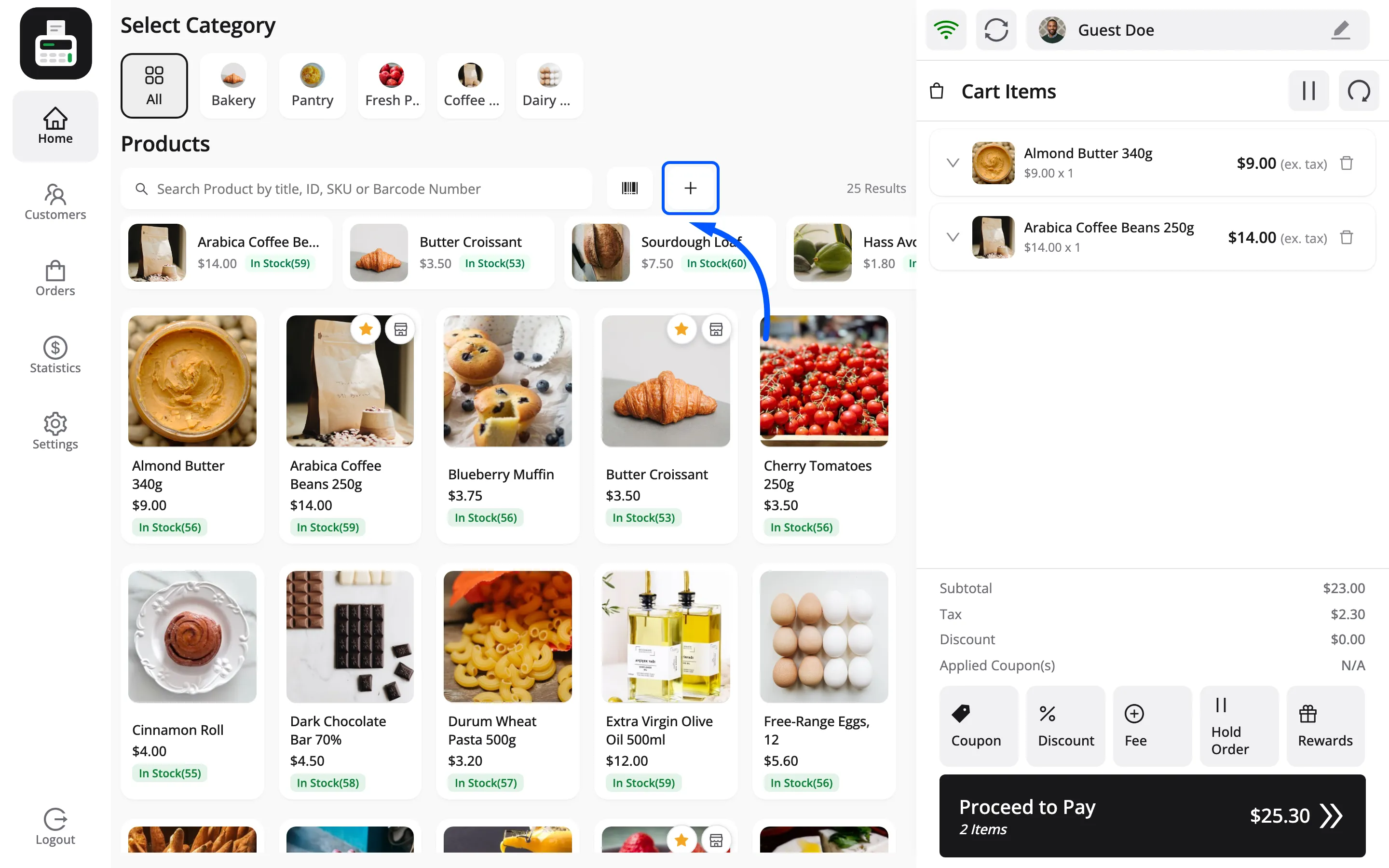
Step 1: Press the plus icon
Section titled “Step 1: Press the plus icon”On the home screen, the plus sits in the search row, just right of the barcode icon.
Step 2: Name it, price it, count it
Section titled “Step 2: Name it, price it, count it”Custom Product Details has three fields and nothing else.
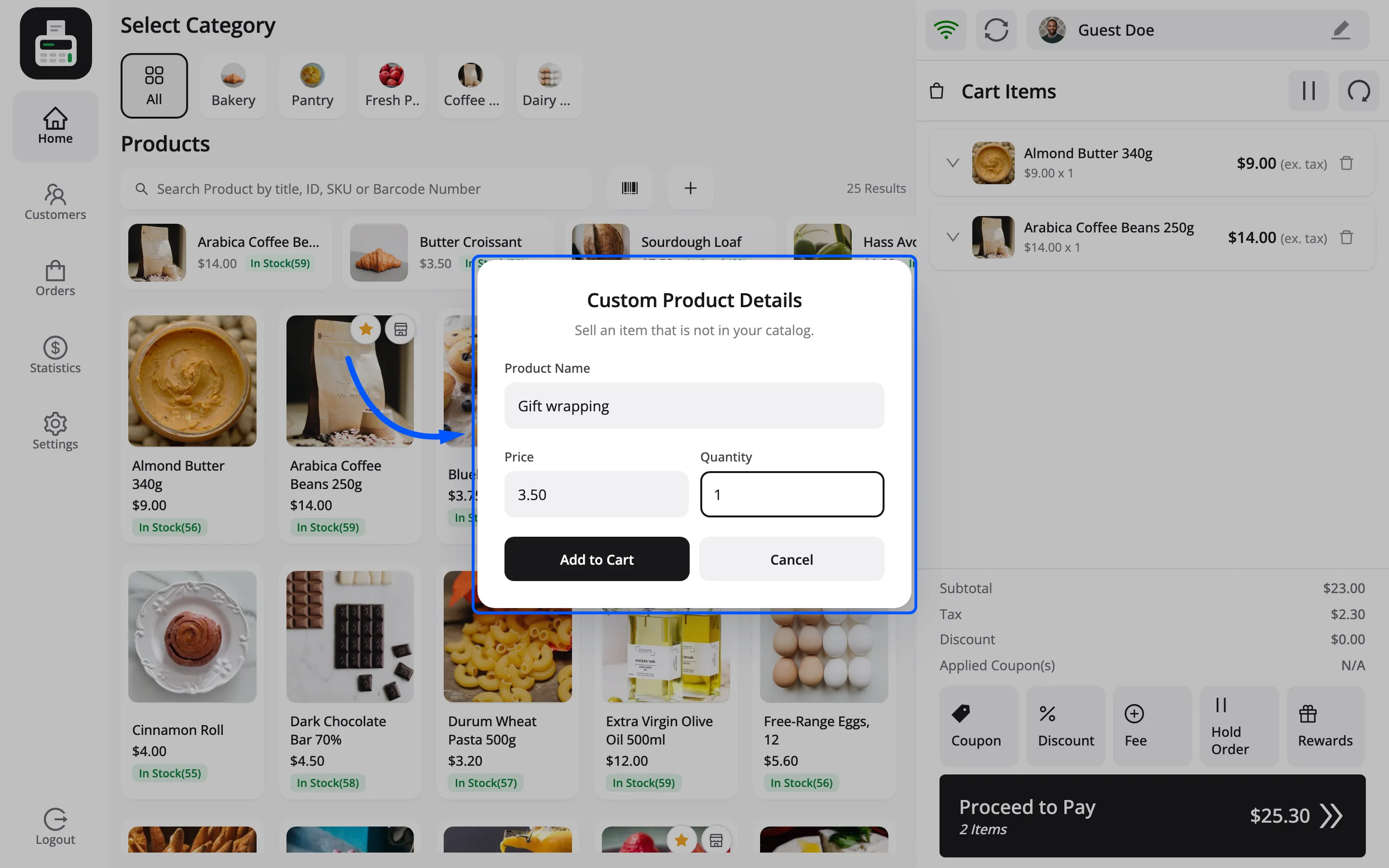
| Field | What goes in |
|---|---|
| Enter Product Name | What the customer will see on the receipt |
| Enter Price | The price for one, in your shop currency |
| Enter Quantity | How many, minimum 1 |
Add stays disabled until all three carry a value. There is no default price and no default quantity.
Name it for the customer, not for you. Repair - watch strap reads well on a receipt; misc3 does
not, and that receipt may come back with a query attached.
Step 3: It joins the cart like anything else
Section titled “Step 3: It joins the cart like anything else”The line behaves normally from there: it counts towards the total, takes tax, takes a discount or a coupon, and prints on the receipt.
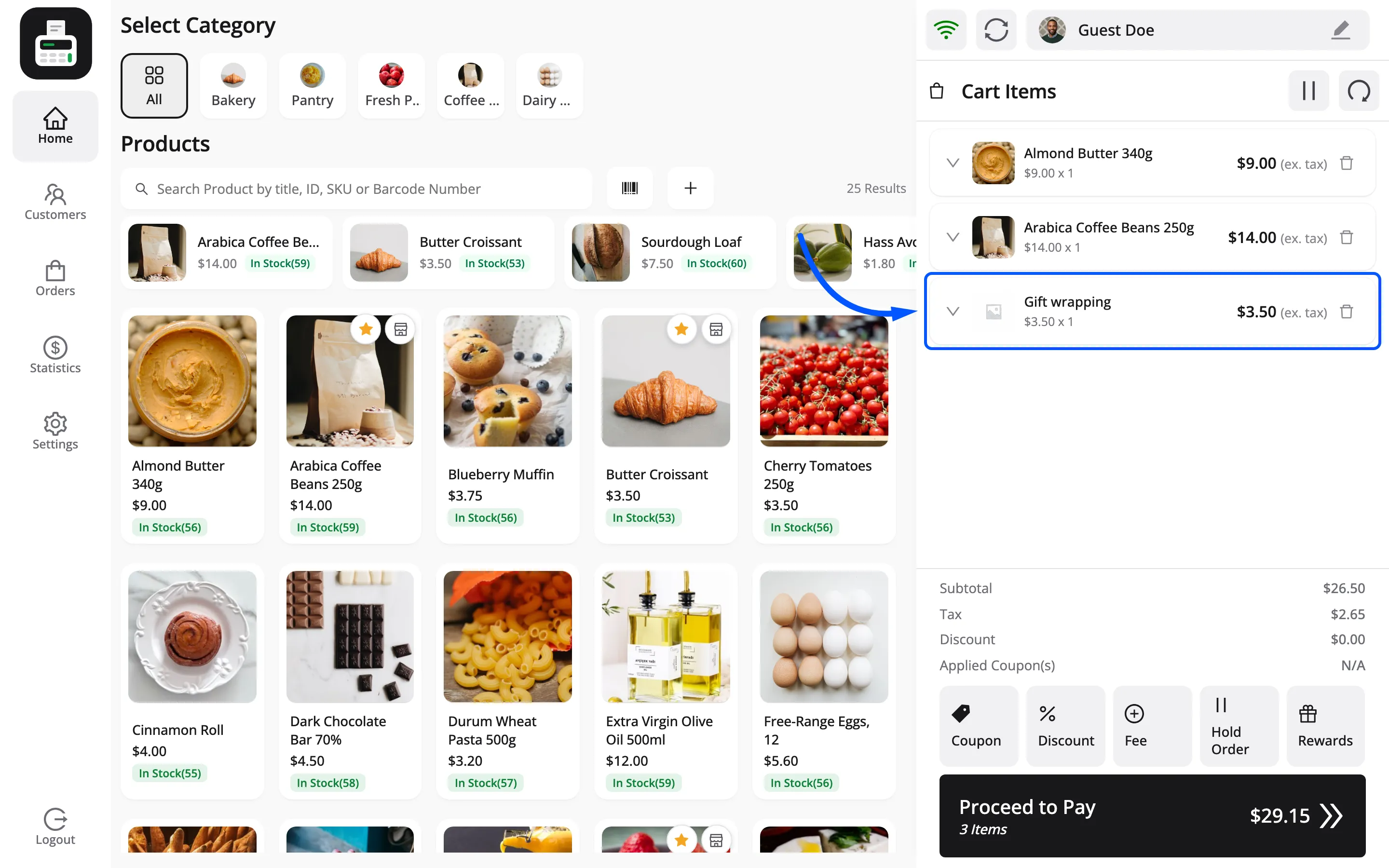
In that shot Gift wrapping at $3.50 sits under Almond Butter at $9.00 and Arabica Coffee Beans at
$14.00. The subtotal reads $26.50, tax $2.65, the total $29.15 across three items. The custom line is counted exactly like
the two real products above it.
It carries the placeholder image, because there is no product behind it to take a photo from. That is the visible sign of what the next three points are about.
Three things it does not do, all for the same reason.
- No stock. There is no product behind it, so nothing is counted down and nothing is counted back on a refund.
- No barcode. It cannot be scanned next time. A charge you make weekly deserves a real product.
- No product reports. It carries revenue, so it shows in sales totals, but it will not appear in any report that groups by product.
Part two: an item priced by weight
Section titled “Part two: an item priced by weight”A product set up to be priced by weight does not go straight into the cart when you tap it.
Step 1: Tap the product
Section titled “Step 1: Tap the product”The POS asks how much, and states the unit price it is about to use.
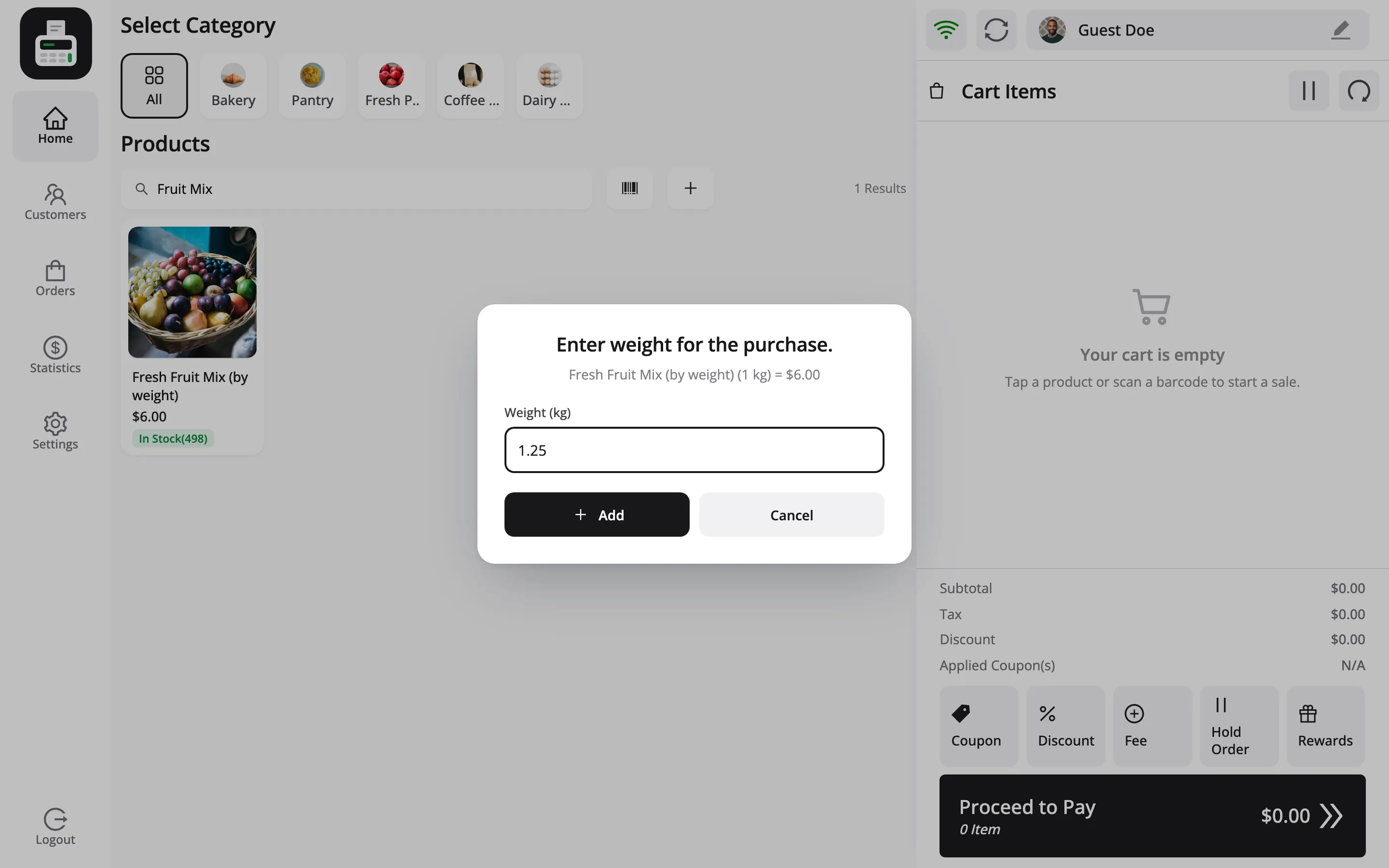
The heading line reads product, unit and price together, so a cashier can check the price is right before weighing anything.
Step 2: Type the weight
Section titled “Step 2: Type the weight”Type what the scales say and press Add. The POS multiplies weight by unit price.
An empty or zero weight is refused with Enter valid weight.
The scales are not connected to anything. MultiPOS does not read a scale; the cashier reads the scale and types the number. Nothing here needs setting up, and nothing will fill it in for you.
Step 3: Check the cart line
Section titled “Step 3: Check the cart line”The cart line carries the arithmetic. Expand it with the chevron to see Quantity and Price Per Unit.
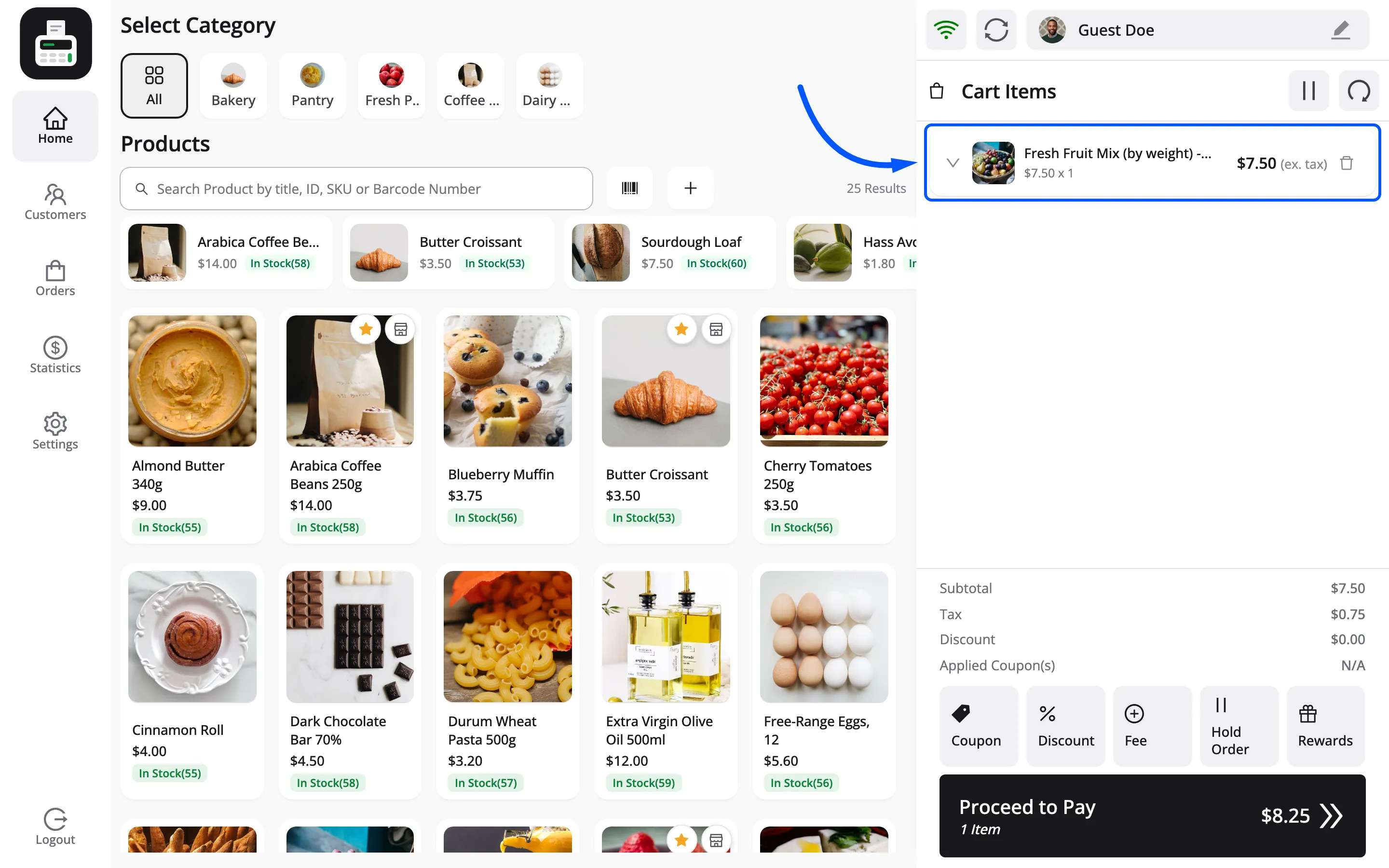
This is the part worth reading twice, because it is not laid out the way you would guess.
- The weight is not the quantity. In that shot 1.25 kg of the $6.00 Fresh Fruit Mix reads $7.50 x 1: quantity 1, at a price per unit of $7.50. The weight has already been multiplied into the price, and the line is one of those.
- The weight itself is not editable. There is no weight box on the line. To correct a mis-typed weight, delete the line and tap the product again.
- Price Per Unit is editable, and on a weighed line that is the only way to adjust the figure. Be careful with it: a cashier who lowers the price per unit has given a discount that appears nowhere as one.
- Quantity works as normal. Two identical 1.5 kg bags is quantity 2 at $150.00 each.
Which one to use
Section titled “Which one to use”| Situation | Use |
|---|---|
| Charge you invent on the spot | Custom item |
| Same charge every week | A real WooCommerce product |
| Priced per kilo, gram, pound | A weight-based product |
| Priced per metre or per hour | A weight-based product, with the unit renamed |
The weight prompt does not care what the unit means. If your unit is metres of cable or hours of labour, set the product up that way and the prompt reads correctly.